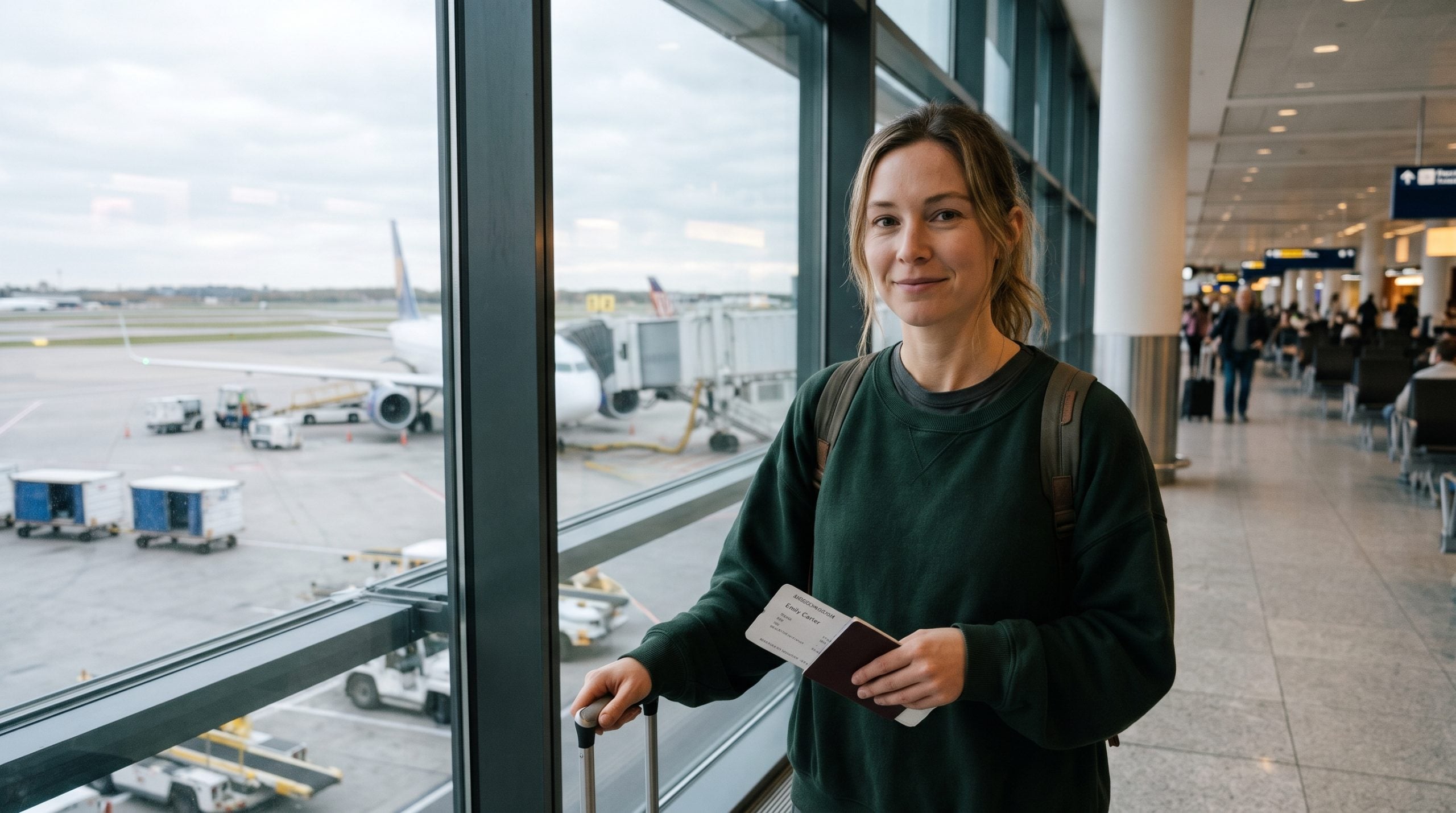
 Emily Carter
The personal item size on the airline’s website isn’t what decides whether your bag gets on. Instead, your bag gets judged at the gate, about forty minutes before departure. The judge is someone like me, holding a boarding scanner while two hundred people line up behind you.
I’ve spent years in airline ground operations. First I worked the gate, and later I became a customer service supervisor. In other words, I’m the person agents call when a passenger says “but it fit last time.” I’ve measured backpacks, settled arguments over tote bags, and watched a lot of people pay for their bag twice. Above all, the same thing causes nearly all of it. People don’t understand personal item size, and they really don’t understand how the rule gets applied at the gate.
So this isn’t a copy of a baggage policy page. Rather, it explains how the rule works from behind the podium. You’ll learn what the numbers mean and why airlines enforce them. You’ll also learn how to walk onto the plane without paying a cent more than your fare.
What a Personal Item Is, and Why Personal Item Size Matters
Every airline uses the same basic definition. First, a personal item is the smaller of your two cabin bags. Second, it has to fit completely under the seat in front of you. For example, a purse, laptop bag, briefcase, small backpack, or camera bag all qualify. Your carry-on goes overhead and must meet a separate carry-on luggage size limit. Your personal item, by contrast, goes under the seat.
The idea is simple. However, the details trip people up all the time.
The Personal Item Size Rule Comes From Federal Safety Regulations
Here’s the part most travelers don’t know. In fact, airlines didn’t invent the under-seat rule to sell bag fees. Instead, it comes from federal safety rules. Under 14 CFR § 121.589, seats that allow bags underneath need a way to stop them sliding forward. That’s the metal bar you sometimes kick by accident.
Similarly, aisle seats need a way to stop bags sliding sideways into the aisle during a hard impact. Moreover, the same regulation requires each airline to run an FAA-approved carry-on baggage program. That program controls the size and number of bags coming on board.
Why Flight Attendants Care About Your Footwell
That’s why a flight attendant won’t let your backpack stick halfway out into the footwell. After all, a bag that isn’t fully behind the restraint bar can block a row during an evacuation. Likewise, the FAA has said seat pockets aren’t approved storage for bags. They’re designed for light items only. As a result, your crew may ask you to move a heavy water bottle or charger before takeoff.
So when I tell a passenger their bag is too big, I’m not inventing a rule on the spot. Instead, I’m enforcing a stowage program the airline must follow by law. To be clear, the fee is the airline’s business decision. You can compare those choices in our guide to airline baggage fees. The fit, however, is a safety requirement.
Personal Item Size by Airline (What I’d Actually Plan Around)
This is where it gets messy, because there’s no industry-wide personal item size. Every carrier picks its own number, and some won’t publish one at all. As a result, here’s where the major U.S. airlines stand as of late 2026.
Personal Item Size Limits on the Legacy Carriers
- United Airlines: 9 x 10 x 17 inches (22 x 25 x 43 cm). This is one of the smallest allowances among the big carriers. Furthermore, it’s the only free cabin bag on most domestic Basic Economy fares.
- American Airlines: 18 x 14 x 8 inches (45 x 35 x 20 cm). Still, it must fit under the seat in front of you.
- Delta Air Lines: No published dimensions. Instead, Delta only says the item has to fit securely under the seat.
- Southwest Airlines: No published dimensions right now. Its policy simply says the item should fit under the seat in front of you. Previously, Southwest listed 16.25 x 13.5 x 8 inches as its smallest under-seat space. That’s still a safe number to pack to.
- Alaska and Hawaiian: No published size. Therefore, under-seat fit is the only test.
Personal Item Size Limits on Low-Cost and Leisure Carriers
- JetBlue: 17 x 13 x 8 inches.
- Frontier Airlines: 14 x 18 x 8 inches, including handles, wheels, and straps. In addition, Frontier uses a dedicated personal item sizer at the gate.
- Allegiant: 16 x 15 x 7 inches. Notably, that 7-inch depth is the tightest on this list.
- Breeze Airways: 17 x 13 x 8 inches.
- Avelo and Sun Country: 17 x 13 x 9 inches.
Spirit Airlines’ Old Personal Item Size Rule
You’ll still find plenty of guides quoting Spirit’s 18 x 14 x 8 inch rule. However, Spirit stopped flying on May 2, 2026, after rescue talks fell through. So if an article still tells you how to pack for Spirit, assume the rest of it is out of date too.
Why Personal Item Size Limits Don’t Line Up
People ask me why United’s allowance is so much smaller than American’s. After all, the planes look the same from the jet bridge. The honest answer is that each airline sets its number based on its own fleet, seats, and fares. In short, a personal item limit is partly a measurement and partly a business decision. Consequently, enforcement is tighter on carriers where the personal item is the only free bag.
The Sizer Is the Real Personal Item Size Rule
If you take one thing from this article, take this. The published dimensions are what the airline says. The sizer, however, is what the agent uses.
Most gates have a metal or plastic frame. Sometimes there are two side by side, one for carry-ons and a smaller one for personal items. So when an agent has a question about your bag, they won’t get out a tape measure. Instead, they’ll point at the box.
What I’ve Watched Happen at the Box
Over the years, I’ve seen the same patterns over and over:
- Soft bags pass or fail on how full they are. For instance, your backpack might measure 17 x 12 x 7 inches empty. Then you add a hoodie, two chargers, a water bottle, and lunch. Suddenly the front bulges three inches past the frame. In other words, the tag on the bag doesn’t matter. What matters is its shape right now.
- Handles, wheels, and straps count. As a result, a wheeled underseater with a rigid handle housing can fail on depth alone. Frontier spells this out, and most carriers measure the same way.
- “It fits if I push it” doesn’t count. On strict carriers, the bag has to go in without forcing. Therefore, if I watch you lean on it, it doesn’t fit.
- Rigid bags lose to soft bags. A soft bag can squash, while a hard-shell case stays the same size however hard you push.
When Personal Item Size Enforcement Goes Wrong
I want to be fair about something. Admittedly, enforcement at the sizer isn’t always perfect, and travelers have pushed back. For example, Frontier faced a lawsuit claiming a gate sizer was smaller than its advertised dimensions. Frontier also admitted it paid agents incentives tied to bag fees after a gate video went viral.
As a supervisor, I find that frustrating. It makes every agent’s job harder when passengers arrive assuming the box is rigged. Even so, it tells you something useful. On ultra-low-cost carriers, expect your bag to meet the sizer, and pack so there’s no room for argument.
Why Your Real Personal Item Size Changes Row to Row
This one catches even frequent flyers. In fact, the space under the seat in front of you isn’t the same everywhere on the plane.
- Bulkhead rows have no seat in front. Consequently, your personal item goes overhead for takeoff and landing. So booking the front row won’t keep your bag at your feet.
- Exit rows don’t allow anything on the floor. Instead, bags go overhead, period.
- Aisle and window seats can have less room. For instance, seat-track hardware, power boxes, and entertainment equipment sit under some seats. That’s why Southwest once described its old figure as the smallest space available.
- Regional jets are tighter. On smaller aircraft, overhead bins often can’t take a standard carry-on. As a result, anything bigger than a personal item may be valet-checked at the aircraft door.
What to Pull Out Before a Bag Gets Gate-Checked
If an agent tags your bag at the door, take out a few things first. Above all, keep spare batteries with you, because a power bank on a plane must stay in the cabin. Also, keep medication and valuables on you. Meanwhile, an AirTag in your luggage helps you follow a checked bag. If you need one, see our pick of the best luggage tracker. It’s useful if your bag becomes a delayed baggage claim.
Choosing a Seat for a Borderline Bag
My advice from the gate is simple. First, a borderline bag has its best chance in a window or middle seat a few rows behind the bulkhead. Then, look under the seat before you sit down. Finally, if a power box is in the way, tell the crew right away, while overhead space remains.
What Doesn’t Count Toward Your Personal Item Size Allowance
This is the most useful section of this article. Even so, it’s the one passengers know least about. Some items don’t count against your allowance at all. So knowing which ones can save you a bag fee.
Assistive and Medical Devices
The Air Carrier Access Act protects travelers with disabilities. Under DOT’s rule at 14 CFR § 382.121, airlines can’t count assistive devices toward a carry-on limit. Specifically, that includes prescription medications and the devices to give them. It also covers vision aids, portable oxygen concentrators, canes, crutches, braces, and similar equipment.
The Medical Bag Catch
But here’s the catch that comes up at my podium all the time. According to DOT guidance, the airline can count a medical bag that also holds personal belongings. For example, a CPAP bag with a CPAP in it is exempt. On the other hand, a CPAP bag with three shirts and a paperback isn’t. Therefore, keep medical equipment in its own bag.
Items for Babies and Small Children
American Airlines, for example, says these don’t count as your personal item or carry-on:
- Diaper bags (one per child)
- Breast pumps
- Small, soft-sided coolers of breast milk
- Child safety seats, strollers, and medical or mobility devices
Similarly, other carriers have exceptions like these, although the wording varies. So check your airline’s page before you leave, especially for diaper bags. Some ultra-low-cost carriers count a diaper bag as your free personal item.
Coats, Small Food, and Duty-Free
Most legacy carriers also let you bring a coat and a small bag of terminal food without counting them. However, the words to watch are “small” and “reasonable.” A coat is fine. On the other hand, a coat with stuffed pockets works like a second suitcase. That’s exactly what gets a gate agent’s attention.
The Combination Trap
Here’s a situation I see on almost every full flight. A passenger has a backpack and a purse, but their fare only allows one personal item.
Most airlines will let you put the purse inside the backpack if the combined bag still fits. The trouble, though, is that people do this right at the sizer, in front of the whole line. Then the backpack that fit fine five minutes ago bulges past the frame.
So do this at home instead. First, put everything you’re bringing on board, purse included, into the one bag. Next, zip it. Finally, measure it. That’s the bag that’s flying.
How to Pack to Your Personal Item Size So It’s Never Questioned
After years of watching which bags get waved through, here’s my no-nonsense checklist. For the security side, see our guide to what you can bring on a plane.
Measure Your Bag Against the Personal Item Size
- Measure the bag packed, not empty. Lay a tape measure along the deepest point, which is usually the front pocket.
- Build to the strictest airline you fly. For example, if you fly United and American, pack to United’s 9 x 10 x 17. That way, your bag passes almost everywhere. Allegiant’s 7-inch depth is the main exception.
- Choose soft over hard. After all, a soft backpack or tote squashes, whereas a rigid case doesn’t.
Pack Smart and Know Your Fare
- Skip the external bottle pocket. A full water bottle on the side adds width. Instead, put it inside, or carry it until you board.
- Wear your bulkiest layer. In other words, your jacket and boots go on your body, not in the bag.
- Use compression cubes, but don’t overfill them. They save space. Still, overfilled cubes turn your bag into a brick that won’t flex.
- Know your fare. Basic Economy on several carriers means personal item only. In fact, cheap-fare passengers with roller bags cause many of the gate fees I see.
- Pay for a carry-on online if you’re unsure. On low-cost carriers, adding a bag at booking almost always costs less than paying at the gate. For instance, Frontier charges far more at the gate than at booking.
If Your Bag Ends Up in the Hold
Sometimes the easiest fix is to check the bag. In that case, look up how much it costs to check a bag on your airline first. Also, weigh it at home, because an overweight baggage fee can cost more than the bag itself.
How to Handle a Gate Agent Who Says Your Bag Is Too Big
Speaking as the supervisor who gets called over, here’s what actually helps:
- Stay calm and ask to try the sizer. If the bag goes in cleanly, most agents will let it go.
- Offer to take something out. For example, pull out the jacket and wear it, or hold the snack bag. As a result, many disputes end right there.
- Don’t say “it fit on my last flight.” It might have. However, a different airline, aircraft, agent, or pack doesn’t change today’s sizer.
- Ask politely for a supervisor if the bag clearly fits. That’s a fair request. On the other hand, raising your voice usually isn’t.
- Document it if you think you were charged wrongly. First, photograph the bag in the sizer. Then keep your receipt and complain to the airline. Finally, if that goes nowhere, file a consumer complaint with the U.S. Department of Transportation.
The Bigger Picture on Personal Item Size
Industry coverage this year has pointed to stricter enforcement of cabin bag rules across the board. That’s especially true as bins fill up and fares get more segmented. To put it plainly, personal item size is no longer something you can skim. Instead, it’s part of what you’re buying when you pick a fare.
Fortunately, this is one travel problem you can solve completely on your own. Pick the right bag, measure it packed, and know your airline’s number. Also, keep medical equipment and baby items in their own bags. If you do that, the sizer is just a piece of metal you walk past.
Personal Item Size FAQs
What is the standard personal item size for airlines?
There isn’t one. Common published sizes range from United’s 9 x 10 x 17 inches to American’s 18 x 14 x 8 inches. Meanwhile, Delta, Alaska, and Southwest don’t publish dimensions at all. SmarterTravel’s airline-by-airline breakdown is a useful starting point.
Does a backpack count as a personal item?
Yes, as long as it meets your airline’s limit and fits fully under the seat. However, a backpack that’s too big is treated as a carry-on. See CNN Underscored’s carry-on size guide.
Do wheels and handles count toward personal item size?
Yes. In fact, airlines measure the outside of the bag, including handles, wheels, and straps. For example, Frontier says so on its bag options page.
What is United’s personal item size?
It’s 9 x 10 x 17 inches (22 x 25 x 43 cm). Moreover, it’s your only free cabin bag on most domestic Basic Economy fares. Confirm on United’s carry-on page.
What is American Airlines’ personal item size?
It’s 18 x 14 x 8 inches (45 x 35 x 20 cm). Also, diaper bags, breast pumps, and medical devices don’t count toward it. Details are on American’s carry-on bag page.
Does Delta have a personal item size limit?
Delta doesn’t publish specific dimensions. Instead, the item has to fit securely under the seat in front of you. See Delta’s carry-on baggage policy.
Do medical devices count as my personal item?
No, because DOT rules exempt assistive devices from carry-on limits. However, the airline can count the device’s bag if it also holds personal belongings. See the DOT’s guidance on assistive device stowage.
What happens if my personal item is too big at the gate?
Usually, it’s reclassified as a carry-on or checked bag, so you may pay a fee. On low-cost carriers, gate prices are usually the highest. The Motley Fool’s report on budget airline bag enforcement explains the cost.
Can I keep my personal item at my feet in the bulkhead or exit row?
No. Bulkhead rows have no seat in front, and exit rows must keep the floor clear. Therefore, personal items go overhead for takeoff and landing. The Points Guy’s backpack guide covers this.
Are Spirit Airlines personal item rules still relevant?
No, because Spirit ended operations on May 2, 2026. See NPR’s report via OPB.
References
- 14 CFR § 121.589: Carry-On Baggage (Cornell Legal Information Institute)
- FAA InFO 09018: Stowage of Items in Seat Pockets
- 14 CFR § 382.121: Mobility Aids and Assistive Devices in the Cabin (Cornell LII)
- U.S. DOT: Assistive Device Stowage, Damage, and Delay
- U.S. DOT: Traveling with a Disability
- United Airlines: Carry-On Bags
- American Airlines: Carry-On Bags
- Delta Air Lines: Carry-On Baggage
- Southwest Airlines: Carryon and Personal Item Policy
- Frontier Airlines: Bag Options
- Deep Arrival: Personal Item Size by Airline in 2026
- SmarterTravel: Carry-On and Personal Item Size Limits for 33 Major Airlines
- The Motley Fool: Spirit and Frontier Are Cracking Down on Luggage
- TravelPulse: Frontier Airlines Hit With $100 Million Lawsuit Alleging Hidden Fees
- TravelPulse: Frontier Airlines Admits Paying Agents for Charging Bag Fees
- OPB/NPR: Spirit Airlines Ceases Operations
- Aviation Week: Spirit Airlines Shuts Down After Rescue Talks Collapse
- The Points Guy: Is a Backpack a Carry-On or Personal Item?
- CNN Underscored: Carry-On Luggage Size Guide
- AOL: Airlines Are Cracking Down on Some Carry-On Rules in 2026